FutureOfWork

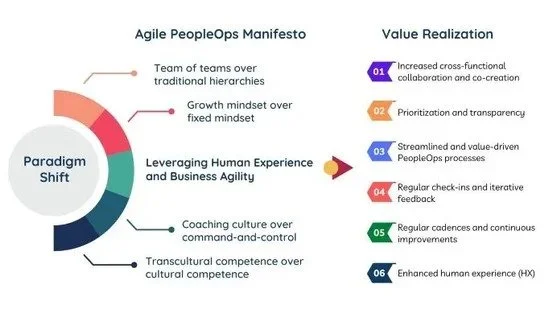
What Agile Organizations Get Right About HR

If you’ve worked inside or alongside an agile organization, you’ve likely felt the difference:

Decisions get made faster. Talent adapts. The people strategy actually supports the business strategy.

But this isn’t magic. It’s the result of an HR function that looks very different from the traditional model.

What agile HR gets right:

  • HR isn’t a silo. It’s embedded in strategic conversations from the start.

  • Data isn’t just collected. It’s applied to solve real business problems.

  • Talent planning is proactive, not reactive.

  • The employee experience isn’t an HR initiative. It’s a shared leadership priority.

  • Speed and flexibility are built into people systems, they are not seen as trade-offs.

These aren’t just nice-to-haves. They’re how agile organizations stay competitive in complex, fast-changing markets.

Where the old playbook breaks down:

  • HR is asked to enable change it had no role in shaping

  • “Best practices” are applied without context or customization

  • Technology is layered on top of broken processes instead of redesigning them

  • HR spends more time policing policies than unlocking potential

The new HR playbook? It’s adaptive, strategic, and fully aligned with business outcomes.

Agile PeopleOps. (n.d.). How to implement an agile HR strategy in your organization. Retrieved November 6, 2025, from https://www.agilepeopleops.com/what-is-agile-hr/

When one of our clients, replaced a traditional focused model with a more agile one built around sprints, strategic business partners, and people analytics it resulted in:

More alignment among Directors and leaders, insights around talent acquisition, sped up productivity of new members, development of less, yet meaningful metrics.

The AI Quietly Reshaping Recruiting (Beyond Chatbots)

AI in recruiting gets a lot of attention for things like chatbots and automated screening. Some of the most impactful tools are the ones working quietly behind the scenes.

Here’s what actually matters—and what real articles show:

AI-powered market mapping at scale – These systems can comb millions of profiles and help you build talent pools you’d never uncover manually. “Tools powered by AI can search vast online sources beyond the usual channels to surface potential candidates. But what makes AI especially powerful is its ability to look beyond skills and experience to locate the right talent.” - Korn Ferry, 2025

Real-time compensation benchmarking – Today’s AI tools give you up-to-date market pay data—right in your workflows. “By using AI, compensation managers can more quickly and efficiently see how pay compares by location, industry, and size. Though just 22% of surveyed companies said they are using AI for external-pay benchmarking, 63% say they are considering using it.” - Business Insider, 2025

Bias-detection in job language – AI can flag biased phrasing before it goes live, helping remove unintended barriers from job descriptions. “AI also enhances candidate matching, reduces unconscious bias in the hiring process, helps to promote diversity and inclusion, and improves the candidate experience.” - Vonage, 2025

These AI tools don’t replace recruiters—they amplify them. They give you the precision, insights, and runway to be strategic.

Chatbots can be useful, but they’re just the starting point, not the full picture of AI’s impact in recruiting.

AI Won’t Replace Recruiters— But Recruiters Who Use It Will

AI isn’t going to replace sourcing, recruiters, or hiring managers.

But talent specialists who know how to use it? They’ll replace the ones who don’t.
The future of hiring isn’t AI or people—it’s both. Get the balance right and you move faster, reduce bias, and make better long-term hires. Get it wrong and you just make bad decisions faster.

Here’s the smart split:

Artificial Intelligence (AI)
Reach and data. Use it to source broadly, screen efficiently, and surface hidden gems.
Humans
Context and judgment. Only people can read motivation, adaptability, and cultural fit.

As the World Economic Forum recently pointed out, “conversational AI serves as a highly effective initial filter, identifying candidates with the right skills while allowing recruiters to focus on more nuanced factors such as cultural fit, communication style, and problem-solving ability. Human oversight also helps refine AI-driven processes, ensuring fairness and mitigating potential biases. Rather than replacing recruiters, AI enhances their role by reducing repetitive screening tasks, making the hiring process more efficient and equitable.”

Solve the problem, not the symptom. At TGP, we approach recruitment and sourcing that pairs tech with human insight, moving more efficiently without losing sight of candidates and clients within the hiring process.

Is Your Approach to Flexible Work Setting You Up to Scale or Setting You Back?

Flexible Work Isn’t a Perk
It’s a business strategy. And if you’re treating it like a “nice to have,” it might be costing you more than you realize.

Let’s Be Real.
Flexible work falls apart fast when it’s not built with intention.
❌ Siloed teams
❌ Stressed-out managers
❌Inconsistent policies
❌Missed goals
❌That awkward “...are they even working?” moment every manager secretly dreads

Sound Familiar?
What worked when everyone was in the office five days a week may not be working now.

Your norms have shifted.

But your systems and expectations haven’t caught up.

And “remote optional” is starting to feel more like “optional accountability.”

Here’s the Truth:
Flexible work isn't a perk.

It's a strategic lever for performance, retention, and culture.

But only if you build it to deliver those outcomes.

The Result?
A people strategy that flexes and scales.

Your best people stay, grow, and win alongside you.