
If you’ve worked inside or alongside an agile organization, you’ve likely felt the difference:
Decisions get made faster. Talent adapts. The people strategy actually supports the business strategy.
But this isn’t magic. It’s the result of an HR function that looks very different from the traditional model.
What agile HR gets right:
HR isn’t a silo. It’s embedded in strategic conversations from the start.
Data isn’t just collected. It’s applied to solve real business problems.
Talent planning is proactive, not reactive.
The employee experience isn’t an HR initiative. It’s a shared leadership priority.
Speed and flexibility are built into people systems, they are not seen as trade-offs.
These aren’t just nice-to-haves. They’re how agile organizations stay competitive in complex, fast-changing markets.
Where the old playbook breaks down:
HR is asked to enable change it had no role in shaping
“Best practices” are applied without context or customization
Technology is layered on top of broken processes instead of redesigning them
HR spends more time policing policies than unlocking potential
The new HR playbook? It’s adaptive, strategic, and fully aligned with business outcomes.
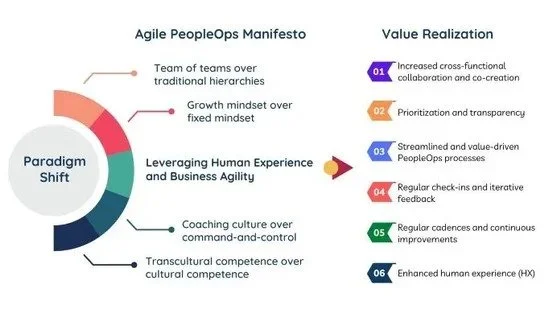
Agile PeopleOps. (n.d.). How to implement an agile HR strategy in your organization. Retrieved November 6, 2025, from https://www.agilepeopleops.com/what-is-agile-hr/
When one of our clients, replaced a traditional focused model with a more agile one built around sprints, strategic business partners, and people analytics it resulted in:
More alignment among Directors and leaders, insights around talent acquisition, sped up productivity of new members, development of less, yet meaningful metrics.