
OrganizationalHealth

What Private Equity Gets Right & Wrong About Talent

Private equity is smart about talent.

They move fast, measure impact, and focus on performance.

They tie compensation to execution.

But here is what often gets overlooked.

At times, they look at the economics of the deal and forget to align the people strategy. This is a costly oversight. 

Research shows that the most successful private equity firms increasingly treat talent strategy as a core driver of value creation, not just a post-deal execution tool (HBR, 2024).

To win beyond the first phase, firms need:

  • Systems that build cohesion of newly established executive leaders

  • Depth of the next level down leadership bench

  • Communications and culture  that retains talent through change

  • People strategy that flexes with business shifts

Real impact isn’t about the spreadsheet and initial investment review.

It is about building systems that last.
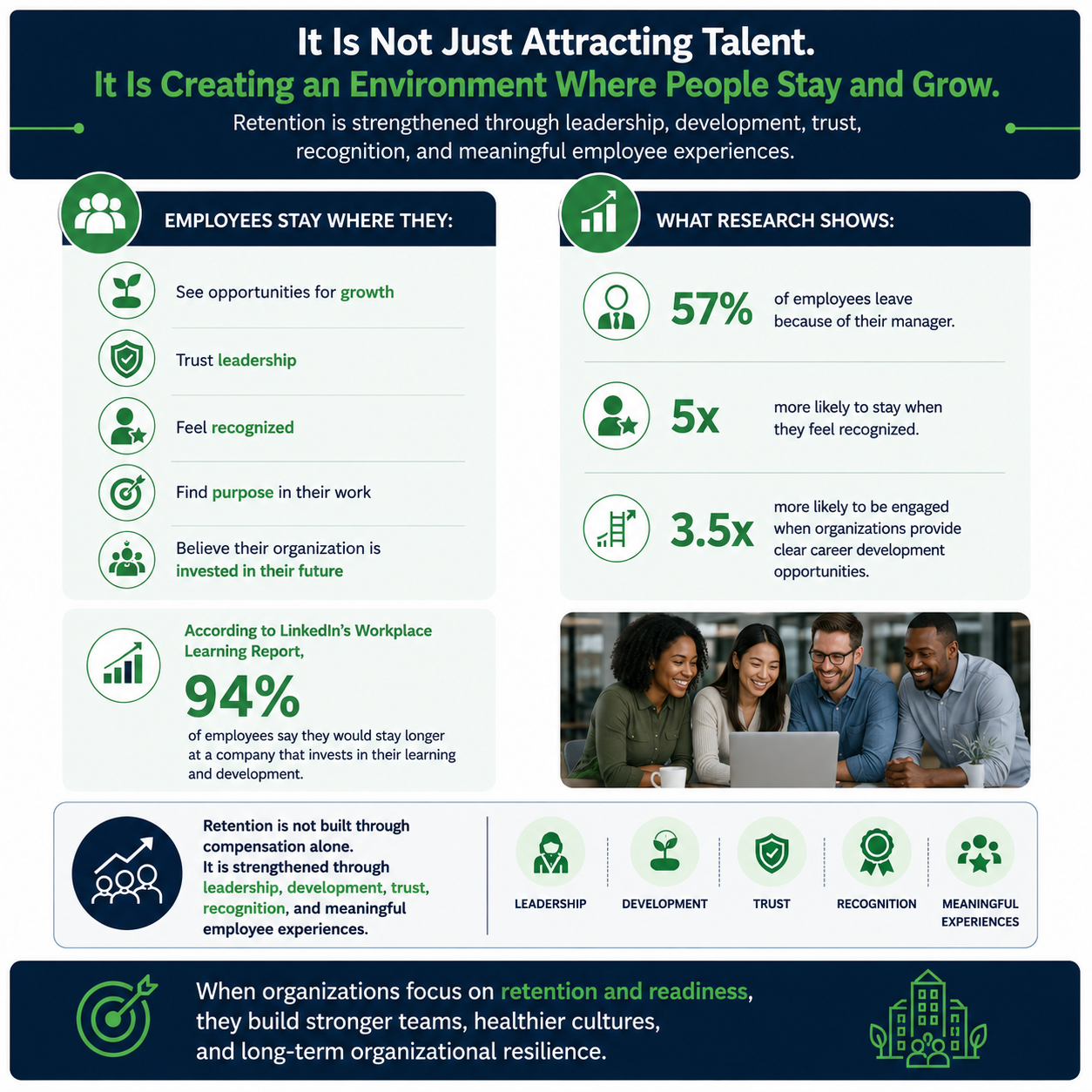
The Real ROI of Talent Strategy Is Retention and Readiness.

It is not just attracting talent.
It is creating an environment where people choose to stay, grow, and contribute consistently.

Employees stay where they:

  • See opportunities for growth

  • Trust leadership

  • Feel recognized

  • Find purpose in their work

  • Believe their organization is invested in their future

According to LinkedIn’s Workplace Learning Report, 94% of employees say they would stay longer at a company that invests in their learning and development.

Gallup also found:

  • 57% of employees leave because of their manager

  • Employees are 5x more likely to stay when they feel recognized

Research from Gartner further shows employees are 3.5x more likely to be engaged when organizations provide clear career development opportunities.

Retention is not built through compensation alone.

It is strengthened through leadership, development, trust, recognition, and meaningful employee experiences.

When organizations focus on retention and readiness, they build stronger teams, healthier cultures, and long-term organizational resilience.

Leadership Pipelines Are Built Not Born

Too many companies chase “ready-made” leaders. But here is the truth.

High-performing leadership is not found. It is developed.

It takes clarity, consistency, and systems that support growth over time.

If your leadership pipeline depends on a few rockstars or external hires, you do not have a pipeline. You have a gamble.

Build leadership by:

  • Defining what great looks like

  • Investing in stretch experiences, not just titles

  • Creating feedback systems that fuel growth

Your starting point does not define your destination. But your development path does.

Talent Without Context Is Just Noise

High-performing people do not thrive in a vacuum. They thrive in systems that give them direction, clarity, and purpose.

You can hire the smartest person in the room. But if they do not understand the objectives, the mission, or the why behind their work, it will not stick and perhaps, they won’t stick around.

Talent only creates high impact when it is clearly aligned.

Aligned to mission.
Aligned to clear outcomes.
Aligned to leadership.
Aligned to a system that holds people to how good work gets done.

The question is not just "Do we have the right person?"
It is “Are we creating the right environment for him or her to succeed and grow?”

Leadership Is Not Title; It Is a System

Most companies treat leadership as a position. But real leadership is built, not assigned.

If you want consistent performance across your teams, you need a system that develops leaders at every level.
This means:

  • Clear expectations for what good leadership looks like

  • Support and feedback loops to help people grow (and give some space for missteps)

  • Alignment across teams so leaders are rowing in the same direction, collaboratively

Leadership is not magic and it is not personality. It is structure, clarity, and follow-through.

Real impact isn’t about quick wins. It is about building systems that last, with aligned consistent leadership