
Beyond Orientation: Building an Onboarding Experience That Performs

A killer onboarding experience does more than make new hires feel welcome, it builds the foundation for performance, trust, and long-term retention.

Yet too often, onboarding is treated like a checklist, not a catalyst.

Here’s what we’re seeing across mid-market companies:

  • New hires are overwhelmed, not oriented.

  • Onboarding timelines are compressed.

  • Managers are unclear on their role in onboarding.

  • Early attrition is creeping up and costly.

  • Culture is being “told” not “shown.

These aren’t just people's problems. They’re growth constraints in disguise. Your people strategy is only as strong as the systems it’s built into.

At Talent Growth Partners, we help build onboarding experiences that drive performance and connection from day one, not just “fill out your benefits form" day one.

Elevate Your Hiring Strategy with Metrics That Matter

If your hiring strategy is still focused on speed alone, it’s time to evolve what you measure.

Time-to-fill will always matter—but it doesn’t tell you:

  • Whether the hire ramped quickly

  • If they will stay

  • If they moved your business forward

The most effective hiring leaders are shifting focus—from filling seats to driving performance, retention, and long-term value.

75% of HR leaders say improving quality-of-hire is their #1 priority in 2025 (HR Executive)

The Latest Research: What Hiring Teams Are Tracking Now

  • Nearly two-thirds (65%) of employers use skills‑based hiring, especially for early-career roles - Companies are screening and interviewing based on demonstrated skills—not just credentials (NACE, 2025)

  • 66% of U.S. TA teams track time‑to‑fill, but only 60% track new-hire retention - Without both, you risk hiring fast—but churning faster (Compono, 2025)

  • 44% of orgs now track quality-of-hire as a key performance metric - It connects hiring to actual business impact (Eightfold x HR.com Report, 2025)

  • Internal mobility and referrals now account for ~15% of hires—and lead to longer tenure (SmartRecruiters, 2025)

Is Your HR Strategy Built to Scale Or Just Built to Survive?

When you're leading in high-growth or high-change environments, the cracks show fast:

  • Your tech stack is fragmented.

  • You’re swimming in dashboards but starving for insights.

  • Teams feel the gap between policy and practice.

  • Your HRBPs are buried in admin work.

  • And you’re realizing: the tools alone won’t get you there.

At Talent Growth Partners, we hear this every day. The consistent truth? Tech is a tool, not a strategy. And without a strategic people lens, even the best HR systems can stall your momentum.

We embed alongside your leadership team to translate business goals into systems that scale, integrating the tech you have, and supplementing what you need.

Here’s what agile organizations get right:

  • They treat HR like a business accelerator, not a compliance function.

  • They bring in seasoned fractional leaders before the pain hits.

  • They use fresh eyes to streamline systems, strengthen culture, and align talent with strategy.

  • They build for what’s next, not just what’s now.

Here’s how we do it:

✅We align your org design to growth goals, not legacy hierarchies.

✅We assess your tools not just for function, but for fit across team size, culture, and workflows.

✅We streamline decision-making across talent, comp, DEI, and performance, so you’re not stuck in analysis paralysis.

✅We focus on building repeatable people practices because real impact isn’t about quick wins; it’s about building systems that last.

✅We bring clarity to chaos and often, a little humor to heavy lifting.


HR tech has a place. But strategy is what gives it stickiness.

The Interview Experience Is the New Differentiator

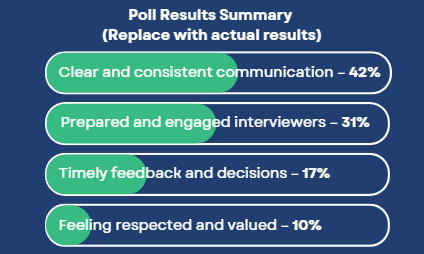
Last week, I asked: What matters most to candidates in the interview process? Here’s what you told me — and what the data confirms.

Top candidates are assessing your company as much as you’re assessing them. They’re paying attention to how your team shows up during the interview process, and a single misstep can cost you top-tier talent.

We’re seeing this firsthand across mid-market firms: the experience you design is becoming just as important as the role you’re offering.

In a tight talent market, the interview is the differentiator.

So what actually matters most to candidates right now?

No surprise: communication and preparation rise to the top. Candidates want clarity. They want to feel like their time is respected — and that your team is aligned.

What the data says:

  • According to a 2023 Harvard Business Review article, a structured and transparent interview process improves candidate satisfaction by 38% — and it’s directly correlated with offer acceptance rates.

  • LinkedIn's Global Talent Trends found that 83% of candidates say a negative interview experience can change their mind about a role or company they once liked.

  • Glassdoor research shows that companies with a strong candidate experience improve quality-of-hire by up to 70%.

🛠️ What this means for hiring teams:

The interview isn’t just an evaluation. It’s a signal. A reflection of your culture. A preview of how you lead.

Ask yourself:

  • Are your interviewers equipped to tell the story of your opportunity and answer tough questions?

  • Are you making decisions and communicating them in a way that reflects urgency and respect?

  • Are your people aligned in the message they send about your values?

  • Are you building genuine connections in the conversation or just checking the boxes?

Client Snapshot

A mid-sized manufacturing client came to us after consistently losing strong candidates mid-process.

The problem?

Candidates were being interviewed on three separate occasions, and asked the same questions each time. Interviewers weren’t aligned, prepared, or building any meaningful connection.

We helped them:

  • Build a clear interview structure with defined goals for each stage

  • Create interview guides so each round covered new ground, not repeated questions.

  • Train interviewers to engage confidently and build rapport, not just assess fit.

Result? Fewer drop-offs, stronger candidate feedback, and 2 top-choice hires in 60 days.